Showing posts with label Books. Show all posts

Friday, July 3, 2015

Ocean Unit - Day Five

Things got pretty hectic around the Mukerji household around this time. Amita had two dance recitals and we have had family visiting in addition to all of our activities.


We started off day 5 by reading our books. One of our books included the book Amita had made the day before. She thought it was neat that we were reading a book she had made. 

After reading we did calendar time.
Following that, Ashima played with daddy for a while and Amita and I did some reading review. I made up a game where I read off words and she had to pick the right one. She got counting bears when she was right and I got bears when she was wrong. She won (by a lot)!


Ashima and daddy came and played a counting game called "hungry monster cup" about a cup that needed a certain number of bears to be happy. This game included a lot of giggles. 
Amita started doing some letter writing


And then I had her do some letter writing with finger paint. The letters were a bit too small and it did not go as I had planned, but Amita had a lot of fun.
Ashima got in on the action, too:
Next, Amita and I wrote some thank you cards. She included her hand print and wrote her own name. 
Ashima played an educational game on the ipad while we did that.
And Amita had some computer time while I cleaned up from the finger painting.
And that took us to nap time!

Ocean Unit - Day Four

Day four started out with four books. Amita really liked reading the Little Mermaid and she was able to read Pig Wig all by herself! Ashima really liked the Dora soccer book. Poor Pedro's Burro, no one really liked it. 


Then, we did calendar time.
Next, we started some pre-writing activities:
Ashima did some coloring/writing too:
Next, Ashima decided to play with some blocks
While Amita worked on making her own book. It included counting, cutting, pasting, painting, and writing. 


When the painting started, Ashima decided that she wanted in on the action:
Of course, the kids needed a snack break:


When we were done we had a brief lesson on folding clothes. The girls both folded their paint shirts and put them away.


And we were done! It was nap time. 

Thursday, September 25, 2014

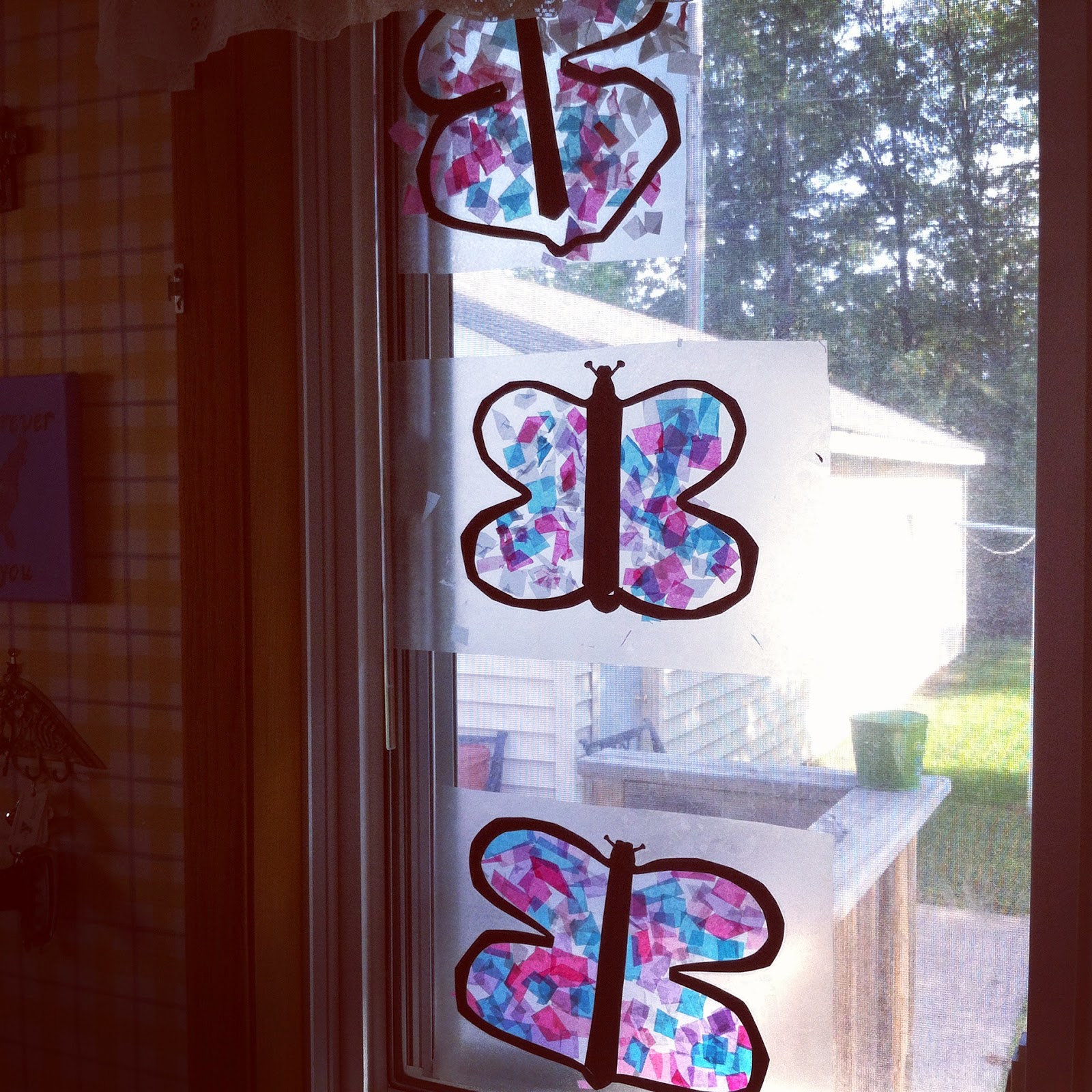
Making Stained Glass Butterflies

One of the girls' favorite activities during the butterfly unit was making "stained glass butterflies", so I thought I would share the lesson. It is very easy, and lots of fun! We made them three times because the girls loved them so much. I am pretty sure all the window in the house have at least one butterfly on them. This lesson could also easily be changed to fit any subject - cars, trains, etc.

Supplies: contact paper, tissue paper, scissors, and construction paper. 

Skills: fine motor skills, color recognition, and counting


First we read the book Glasswings, A Butterfly's Story by Eliza Kleven. I rented it from our local library. It is about a glass winged butterfly who gets lost in a big city and helps the other animals to grow a garden. 


Next, I took contact paper and cut it to approximately 12 X12, and then cut the outline of a butterfly out of construction paper to fit inside the frame of the contact paper (which I totally eyeballed), making sure to leave the sticky side up - this is where you will attach the tissue paper. I took a few sheets of whatever tissue paper I had lying around and cut it into small squares. Next, I had the girls put the tissue paper on the sticky side of the contact paper until all the space was filled. We talked about the different colors and counted how many pieces of paper were going on the butterfly and whether our butterflies looked like the butterfly in the story.


Amita was very diligent and tried to keep in within the outline of the butterfly

Ashima, not so much, but that's okay. She loved the process!
Then, I put them up on the window. Voila! When the light shines through, it looks like stained glass! So easy and fun with both kids!


Thursday, June 5, 2014

Book Review: Hands Free Mama by Rachel Macy Stafford


I give this book a rating of 7/10. The book is available here. 

I had really good intentions when I rented this book from the library. I thought it would give me all sorts of practical advice about how to  be less connected to technology. What I found, though, is that it is written to persuade the reader to become hands free. I have already decided to do this, and made strides to do so (no TV, no computer in the afternoon, etc.), so much of the book - personal anecdotes and such - were very unnecessary for me since I had already decided and was in agreement, even though they were cute stories. As for the rest of it - having designated "technology time" and reasons why you shouldn't be on your computer all the time, I already do that. I found that the book was trying to persuade me to believe in something I already believe in. It contained no real practical advice except to play with your kids and leave your phone on vibrate. After waiting two months on the library waiting list, I was a little disappointed. However, I do love the message of the book so I'm giving it a higher rating. It did have some lovely messages in neat fonts and I enjoyed reading them. :)


Thursday, April 3, 2014

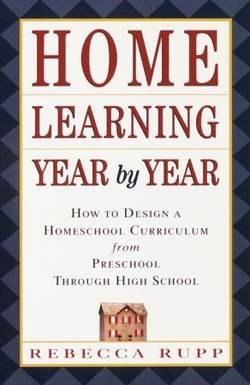
Book Review: Home Learning Year by Year


I give this book at 9/10. It is available here. 

I originally rented the book from the library and ended up purchasing it from amazon. I found it incredibly helpful and informative. 

Let me start out by saying the only reason I didn't give it a 10/10 is because the copyright is 2000. The one I bought on amazon is 2009, so it is still out of date. However, the information is so informative I decided it didn't matter. 

The book is divided into 14 sections - preschool through 12th grade. Each section is subdivided into different subjects and corresponding resources for the subject. So, if you were interested in Preschool, you could find information about preschool, early childhood resources, magazines for parents, magazines for preschoolers, books for parents, books and resources from kids, and best reading lists. If you were interested in 6th grade mathematics, you could find information on what they should know in 6th grade, number theory, ratio and percent, fractions and decimals, operations, measurement, probability and statistics, geometry, and pre algebra. They also have non-core subjects like music, foreign language, health and physical education, and art covered. This book is an organized list of resources and age appropriate materials - a perfect resource for me.

One of my biggest questions about homeschooling was how I was going to know grade-level indicators. This book answers that question and gives me confidence and peace of mind that I will not be leaving anything out of my homeschooling curriculum.

This book is a keeper!

Side note: I think this book could be very informative for parents with children in school to make sure they are meeting all necessary milestones and learning goals. Additionally, I think it could be useful for teachers since it has some great resources and ideas. 

Wednesday, March 26, 2014

Book Review: The Complete Daily Curriculum - Over 1200 Easy Activities to Support Multiple Intelligences and Learning Styles.


I would give this book a 6/10 for homeschooling parents and a 9/10 for traditional preschool teachers. It is available here.

This book would be very useful in a traditional preschool with many students, supplies, materials, and a library, but I found it a bit cumbersome in a homeschool environment with one child and limited materials.

The Complete Daily Curriculum has A LOT of activities - many more than is advertised on the front cover because each activity is expanded to include multiple intelligences. Ideally, you could pick which learning style your child would respond to best and use that only those activities for that style. Once neat aspect of the book is that they have "story circle" books - independent children's books that are related to the theme of each activity. This would be very useful in a traditional school. In a homeschool environment, though, I would have to go to the library and check out the books in advance of even doing the activity.

All of the activities needed quite a bit of prep time. I discovered that I would prefer to find something online that required less prep time than use a lesson in the book. There is an appendix in the back with worksheets and cutouts. They were really neat and could be a lot of fun to do but I didn't find them useful because I don't have a copier, scanner, scrap materials, etc. In a school it would be very useful because all of those things are readily available but it just isn't practical for homeschoolers. For instance, in one activity, I was to find feathers, 6 books for story time, print and cut out 2 pictures from the index, get out crayons and scissors, and paper. This is in addition to learning 3 songs from the index to teach. It's too much work for me for one single lesson! 

I was glad to have a chance to go through it and get a few ideas but I will not be purchasing this book. 

Wednesday, March 19, 2014

Book Review: Mudpies to Magnets - A Preschool Science Curriculum


I give the book a 10/10. I originally rented it from the library but ended up purchasing it for future use. It is available here.

Mudpies to Magnets is divided into eight categories: science center activities, circle time activities, construction and measurement, paints and prints, science for a special place (meaning messy activities), health and nutrition, outdoor science, creativity and movement, and hodge podge.

Lessons include key words, materials, directions, discussion questions, and ways to expand the "experiment". Lessons are broken down and explained clearly. I had no trouble understanding what I was supposed to do.

Each lesson is labeled with its corresponding age, 3 year-old, 4 year-old, or 5 year-old, so parents don't have to read the entire lesson to determine if it is age appropriate. A definite time saver!

The lessons are very creative yet rooted in important scientific concepts. They are not overwhelming to do with a young child and don't seem to create too much a mess. Additionally, they don't need more than basic prep work: some time to gather materials (mostly what we have around the house), and time to read the directions.

This is a winner, for sure!

Sunday, February 16, 2014

Book Review - The Educated Child

I give this book an 8/10. I liked it and thought it was a good place for me to begin my homeschool journey. I feel, after having finished it, that I have a good preschool base from which to begin with Amita. It was not specifically written for home schoolers, but rather for parents who are want to make sure that their children are getting the best education possible whether it be in public, private, or homeschool. If you are interested in buying it, it can be found here.

It is written in several sections: Preschool years, Core Curriculum for Elementary and Middle School, and a section called "Making it Work". Each section has subsections that cover everything from the necessity of preschool (whether it is needed or not) to "Good books for Junior High". It covers everything a parent would need to know (academically, socially, and emotionally) from birth through eighth grade. Much of it is very good information and I enjoyed learning a few new things. Ideally, one would buy this book and keep it on a shelf for reference and only read the pertinent parts during those years. 

The preschool section specifically had useful information for me: kindergarten preparedness, book lists, getting ready to write, read, speak, and listen well, preparing for music, science, and math, and how to build character. Even though it is out of date, I feel like these are skills that are still needed for kindergarten and it was good to give me some long-range goals to work with as I preschool.

Because I'm ALWAYS looking for book recommendations, I really enjoyed the Classic Book list they included. Here it is: 


Classic Books Every Preschooler Should Read:

  1. Alexander and the Terrible, Horrible, No Good, Very Bad Day, Judith Viorst
  2. Are You My Mother?, P.D. Eastman
  3. Ask Mr. Bear, Marjorie Flack
  4. Caps For Sale, Esphyr Slobodkina
  5. The Carrot Seed, Ruth Krauss
  6. The Cat in the Hat, and other books by Dr. Seuss
  7. A Child's Garden of Verses, Robert Louis Stevenson
  8. Corduroy, Don Freeman
  9. Curious George, Hans Rey
  10. Danny and the Dinosaur, Syd Hoff
  11. Frog and Toad Are Friends, Arnold Lobel
  12. Goodnight Moon, Margaret Wise Brown
  13. Harry the Dirty Dog, Gene Zion
  14. If You Give A Mouse A Cookie, Laura J. Numeroff
  15. Little Bear, Else Holmelund Minarik
  16. The Little Engine That Could, Watty Piper
  17. The Snowy Day, Ezra Jack Keats
  18. Madeline, Ludwig Bemelmans
  19. Make Way For Ducklings, Robert McCloskey
  20. The Polar Express, Chris Van Allsburg
  21. Richard Scarry's Best Storybook Ever, Richard Scarry
  22. The Runaway Bunny, Margaret Wise Brown
  23. The Story of Babar, Jean de Brunhoff
  24. The Tale of Peter Rabbit, Beatrix Potter
  25. The Very Hungry Caterpillar, Eric Carle
  26. There's a Nightmare in My Closet, Mercer Mayer
  27. There Was an Old Lady Who Swallowed a Fly, Simms Taback
  28. Where the Wild Things Are, Maurice Sendak
  29. Where's Spot, Eric Hill
  30. Winnie-the-Pooh, A.A. Milne
This is NOT my list. It belongs to The Educated Child.

There were a few things I did not like about this book, hence my 8/10 book review. The first thing is that it is copyrighted in 1999 and woefully out of date about what is going on in the public schools, which it spent a lot of time discussing. I also felt it highlighted the problems of public schools instead of focusing on how to work within the system a little more, for parents who choose to go that route. 

That being said, I felt it still had some really good information and helped me feel more prepared to teach preschool to my kids, so I give it an 8! 


Friday, February 14, 2014

Literacy Based Helpful Websites, Links, and "Stuff"

A while ago, I went to a Parents as Teachers literacy meeting. The meeting was all about how to encourage a love of reading in children. I found it very interesting and thought I would share some of the information.

Websites:

  • Storyline Online. At this website, you can choose a book to be read to your children by a famous person. Just looking at the first page, they have readers like Haylie Duff, Betty White and Elijah Wood. I like putting this on when I'm trying to make dinner and need the girls to sit still for a while. 
  • Robert Munsch. Robert Munsch is a very popular children's book author. My favorite book by him is called "Love You Forever" and I swear it makes me cry every time I read it (I'm not talking a lady-like cry either - I'm talking about a nasty, ugly, must-call-my-husband-and-cry-to-him-even-though-he-just-rolls-his-eyes-and-tells-me-to-get-over-it kind of cry). At his website, if you click on the "books" tab, you can choose books and listen to an audio file of Robert reading his own books. 
  • Star Fall has all kinds of materials for pre-reading, phonics, letter recognition, and phoneme practice. Additionally, if you click on the Learn to Read tab, you can choose from a variety of early reader books the child can practice and play with. 


Some good authors for young children:

  • David Shannon, most famous for the No David books. Funny anecdote: After this conference, I went to my public library online and requested some of the books mentioned thinking that I was an awesome Momma. I go to pick up the books with the girls making a very big deal about all of the fun books we were getting. By bedtime, Amita could hardly sit because she was so excited about the books. I let her pick which one she wanted and she picks the No David book. I sit down, put the girls on my lap, and open the book only to find out that it was in SPANISH! That's right, Mommy of the Year requested the Spanish version. (((Sigh))). We just made up our own story for the night but I got the distinct impression that Amita was a little underwhelmed after how much I had built up the new awesome books. I still haven't read her the actual book. 
  • Mo Willems, talked about in my post earlier for his awesome book Knuffle Bunny. He also writes the Pigeon series. 
  • Jan Thomas writes Can You Make a Scary Face? and Rhyming Dust Bunnies, among others. 
  • Iza Trapani has some good books with great illustrations.
  • Gail Gibbons has some really neat non-fiction books. 


Some good series books for children:


Some other gems from the meeting:
  • Don't forget about the importance of non-fiction with early readers. It is important for them to have a wide base of knowledge - a lot of which can only come from non-fiction. I mean, it's not like they come across Bengal Tigers and the French Alps in daily life - but it is still important to know what those things are. National Geographic for Kids has a magazine for kids. Time Magazine also has Time for Kids with some great resources. I've thought about getting my kids a magazine subscription but have just assumed that Ashima will tear it up and eat it. Maybe when they are a bit older. 
  • Scholastic also has a lot of resources. Remember those book fairs when we were kids? They were awesome!
  • Remember Highlights? It was one of the best things about going to the Doctor's office when I was a kid. Again, I've thought about getting this for my kids but want to wait until Ashima is past the paper eating phase. 
  • Rereading books to kids is a lot like listening to your favorite song over and over. This phrase has given me the ability to read Night Night Little Pookie about 8,000 more times than I would have other wise. I had, at one point, also hidden some books around the house that I swore up and down I just couldn't read EVER AGAIN. I dug most of them out and gave them back to the kids feeling only mildly guilty for hiding them in the first place. 
  • Rhyming is very important for early reading. It helps kids make connections. Say, for instance, they are sight reading a word they haven't seen before: Hat. If that have also seen the word Cat, and know that they rhyme from reading the Cat and the Hat, it will be much easier for him/her to figure out the new word than it would if they didn't recognize the rhyme. 

The biggest thing I took away from the meeting: literacy in children starts with us, the parents. We need to be open to reading (and rereading and rereading and rereading) books to our children. We need to be the ones to show them the joys of a good book. We are the ones who plant the seeds and then watch them grow as the children grow. 


If any other mommas/educators have more links/helpful material, please comment on this post and I will add it. Let's all share the great information we have!

Wednesday, February 12, 2014

What I Do To Ensure Daily Learning of Major Concepts

In addition to lessons plans, which I don't always have time to plan for, we have certain things we do every day to continue working on main concepts I want the girls to learn. Here are some of the things we do:

ABC banner - I put a chain of letters up down the hall. When we go down the hall, I have Amita point to a letter or sing our ABCs. If she asks for something, I'll tell her she can have it after she points out the letter G, etc. It is a great way to reinforce her letters.

Color banner - This is the same concept as the ABC chain. Sadly, this chain no longer exists as Amita pulled all of the papers off the chain and gave them to Ashima who proceeded to eat them. I am thinking about getting some laminated and trying again.

Bulletin board - On days when Amita seems like she is willing to pay attention, we review many things on the bulletin board: days of the week, ABCs, seasons, months, shapes, and colors.


I will probably change these as necessary during the learning process. Currently, these are the main concepts we are working on so I want the girls to really grasp and practice them daily. It is really nice to always have something I can work on with the girls even when I don't have time for a formal lesson.

Tuesday, February 11, 2014

Children's Book Review - Knuffle Bunny by Mo Willems

Rating: 10/10


I love Mo Willems.  For those of you who don't know, Mo Willems is an author of many children's books including the very famous Pigeon series. Amita also likes "Edwina, the Dinosaur Who Didn't Know She Was Extinct".

Knuffle Bunny is a cautionary tale about a little girl (Trixie) who loses her Knuffle Bunny and tries to tell her Daddy. One of my favorite things about it is that it helps to teach empathy. Most of the book Amita and I spend talking about how Trixie feels. Is she happy, sad, crying, worried, etc.? This book helps Amita further her understanding of the world by learning how to read facial expressions and empathize with characters.

I love it, and Amita does too!

Wednesday, February 5, 2014

Book Review: You've Decided to Homeschool, Now What? by Marsha Hubler

Overall, I would rate this book at a 4/10. It had some good information and explained a few things but I did not find it extremely helpful. I also felt it was biased toward the state the author was from (Pennsylvania)  and biased towards those that Christian Homeschool. The author provided many quotes from the bible as well as many laws in Pennsylvania that are not applicable in Wisconsin. 

One thing I did like is that she described the different methods of homeschooling, conventional, unit studies, and also explained the "unschooling"movement. This is a movement I had come across in my research and never completely understood so I was grateful for a clear and concise explanation. 

I also found out that some public schools have homeschool coordinators - something that I need to look more into and would be a great resource if available in WI.  

She also listed several popular curricula. The only thing I didn't like was that the vast majority were Christian-based and the book was copyright in 2007 so I'm not sure exactly how current the information will be. 

Overall, I thought it explained a few things I had been wondering about but didn't have too much information that applies to me. 


Beginning the Overwhelming Research Journey

When I first started researching homeschooling, I was completely  overwhelmed. I was on Amazon looking at book after book, all fairly expensive, none of which I was sure would help. My beginning knowledge base was too small and they were all too specific. I was not homeschooling for religious reasons and I had absolutely no clue where to start. Curriculum? Co-ops? Math? Science? Reading? There were too many options and no clear path forward I quickly got frustrated.

My next line of defense in the homeschooling research battle was the public library. It turned out they had a ton of great resources for those just staring homeschool. I am working on making my way through the books and will write interesting things from each book as well as an overall review of the book. So far they have been tremendously helpful (and free!).

I plan to spend some money to purchase curriculums, materials, and supplements. However, I'm going to do it once I know what the heck I'm doing. Until such time, these books are providing the foundation for me to figure out how I want homeschooling to work for our family. Once I have some basic questions answered, I can move to the more specific books.

These are my main questions regarding beginning homeschooling:


  1. What does homeschooling look like on a day-to-day basis?
  2. What curriculum do I choose? How do I pick?
  3. How do I know that the girls are meeting grade-level markers and indicators?
  4. How do I evaluate their knowledge?
  5. How do I know what they need to know at any given time? 
  6. How do I teach preschool/elementary school concepts (I'm not an elementary teacher!)?
  7. What kind of co-ops exist in the area we will be moving to?
  8. What resources are available for parents?
  9. What kids of social activities are available for home schooled children?
  10. Exactly what parts of the public education can I use (art, music, PE, IEP services, etc.)?
  11. What are the Wisconsin state requirements for homeschooling and what paperwork is required to be submitted to the state?
  12. Does the local public school offer any homeschool resources (Parents as Teachers, homeschool coordinators, etc.)?
It is my hope that through internet research and the resources shown below I should have a very good knowledge base by the time I am finished.